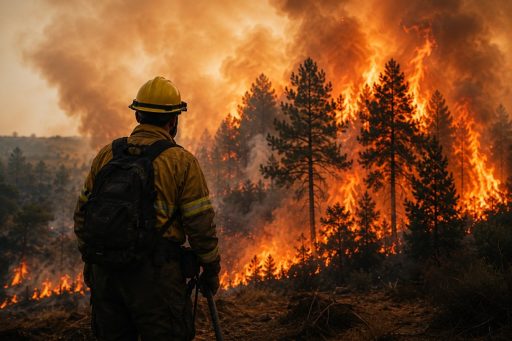
The wildfires recorded over recent weeks have led to the approval of Royal Decree-Law 20/2026 of 29 July, which introduces a series of extraordinary measures aimed at protecting employees and businesses affected by these emergencies.
The purpose of the legislation is to address situations in which civil protection measures—such as evacuations, access restrictions, or confinement orders—prevent normal work activities from being carried out. To this end, it establishes specific mechanisms that complement the existing provisions of the Spanish Workers’ Statute and the General Social Security Act.
A New Extraordinary Benefit for Extreme Emergencies
The main innovation introduced by the new legislation is the creation of a specific entitlement for employees who are unable to perform their work as a direct consequence of wildfires.
In such cases, employees may request the temporary suspension of their employment contract and apply for an extraordinary extreme emergency benefit, which is treated as a contributory unemployment benefit, provided that the legal requirements are met.
These include, among others:
- Being unable to access their habitual residence due to evacuation orders or restrictions imposed by the authorities, where this prevents them from retrieving the essential belongings required to attend work and remote working is not possible.
- The need to devote working hours to cleaning, relocating, repairing the home, recovering personal belongings, or completing essential in-person administrative procedures arising from the emergency.
- The need to provide care for a spouse, registered partner, relatives up to the second degree of kinship, or other members of the household affected by the wildfires.
This benefit is subject to an exceptional regime, as it does not require a minimum contribution period. It amounts to 70% of the regulatory base salary, may be received for a maximum of four months, and does not reduce future unemployment benefit entitlements. During the suspension of the employment contract, the Spanish Public Employment Service (SEPE) will assume responsibility for the employee’s Social Security contributions, while the employer will be exempt from paying its own contributions.
Through this measure, the legislature aims to ensure that employees facing the immediate consequences of a major emergency do not suffer undue financial hardship or jeopardise their employment relationship.
Extension of Bereavement Leave
The legislation also introduces specific rules governing deaths related to wildfires.
In these circumstances, the paid bereavement leave provided under the Workers’ Statute is extended from the date of death until five working days after the funeral, providing greater protection for those affected during a particularly difficult time.
This extension also applies to public sector employees and worker-members of cooperatives, ensuring a consistent approach across all employment sectors.
Labor
Advice on labour law and Social Security: contracts, dismissals, litigation, ERTE and labour audits. We protect your rights and your company with strategic solutions. Avoid legal risks with experts. Learn moreStronger Protection Against Retaliation
Another significant aspect of the Royal Decree-Law is the strengthening of legal safeguards for individuals exercising these newly established rights.
Accordingly, any adverse employment decision taken because an employee has requested suspension of the employment contract, the extraordinary benefit, or any of the measures established by the legislation may be declared null and void, thereby reinforcing judicial protection for employees in situations of particular vulnerability.
Social Security Measures
The Royal Decree-Law extends beyond employment matters and also introduces several measures designed to reduce the economic impact of wildfires on both self-employed workers and businesses.
For self-employed individuals, access to the extraordinary cessation-of-activity benefit has been made more flexible where they are required to suspend all or part of their business activities due to the wildfires. Exceptionally, there is no requirement to demonstrate either the minimum contribution period or the force majeure conditions normally applicable. The benefit may be claimed with effect from 22 July 2026 for a maximum period of four months.
Furthermore, businesses implementing a temporary workforce adjustment plan (ERTE) due to force majeure arising from the wildfires may benefit from a 100% exemption from the employer’s Social Security contributions for the period from August to November 2026, provided that the statutory requirements are satisfied, including the commitment to maintain employment.
In addition, Royal Decree 643/2026, approved on the same day, introduces several amendments relating to Social Security administration. These include extending the deadline for notifying employee deregistrations and changes in employment data from three to six days, as well as requiring employers to report the occupational classification code of all employees who remain registered with the General Treasury of the Social Security System, with a compliance period of six months from the entry into force of the new legislation.
The adoption of these measures highlights the need to adapt Spanish labour and Social Security legislation to emergency situations that are becoming increasingly frequent. For businesses, this means understanding not only the new rights granted to employees and self-employed workers, but also the obligations they must fulfil to ensure proper implementation of these measures and minimise the legal and operational risks associated with their application.
