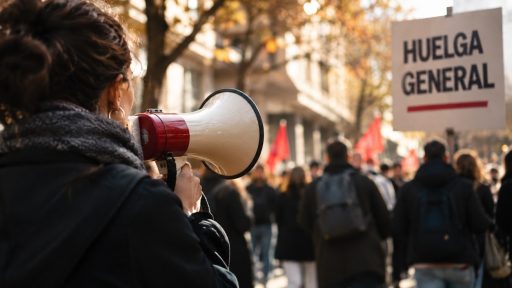
Following yesterday’s strike in Spain, at Ayuela Jiménez we examine the main limitations on employers’ actions, the employment-related consequences of participating in the strike, and the legal risks arising from organisational decisions.
The strike held in Spain on 11 November 2026 has once again highlighted the importance of properly managing employment relations in situations of collective labour disputes. Such industrial action raises significant legal questions concerning work organisation, business continuity and the protection of employees’ rights.
The right to strike, recognised under Article 28.2 of the Spanish Constitution and primarily regulated by Royal Decree-Law 17/1977 of 4 March on Labour Relations, must be balanced against employers’ managerial and organisational powers. At Ayuela Jiménez, we examine the main employment law implications that companies should consider to ensure that their actions remain within the limits established by legislation and case law.
1. Employers’ Managerial Powers and the Replacement of Striking Employees
The calling of a strike does not necessarily entail a complete suspension of business operations, as employees who decide not to participate may continue performing their usual duties. However, employers’ organisational powers are subject to restrictions where the measures adopted are intended to replace employees exercising their right to strike or to neutralise the effects of the industrial action.
Article 6.5 of Royal Decree-Law 17/1977 prohibits, subject to legally established exceptions, the recruitment of external workers to replace striking employees, a practice known as external strikebreaking. Furthermore, Spanish case law has extended this protection to certain forms of internal strikebreaking, where the duties of other employees are exceptionally reassigned to cover the work of those participating in the strike. It is therefore essential to distinguish between the ordinary continuation of business activities and organisational changes specifically designed to compensate for strike-related absences.
2. Remote Working and the Use of Technological Resources
The introduction of remote working arrangements and the digitalisation of production processes have raised new legal questions regarding strike management. Although these tools facilitate the continuity of certain business activities, their use must comply with the limitations arising from the fundamental right to strike.
In particular, exceptionally imposing remote working arrangements to avoid the effects of a strike may constitute an infringement of this right, especially where remote working does not form part of the employees’ previously established working conditions. This situation must be distinguished from the continuation of remote working arrangements already in place. Similarly, the exceptional use of digital tools or automated processes to replace the work of striking employees may raise legal concerns, making it necessary to assess the specific circumstances and purpose of the measures adopted.
Labor
Advice on labour law and Social Security: contracts, dismissals, litigation, ERTE and labour audits. We protect your rights and your company with strategic solutions. Avoid legal risks with experts. Learn more3. Employees’ Rights and the Continuity of Essential Services
The decision to participate in a strike is an individual right of each employee. Consequently, employers cannot require employees to give advance notice of their intention to participate, nor may they exert pressure or impose retaliatory measures in response to the lawful exercise of this right. This protection must be balanced against the rights of employees who choose to continue working, with employers maintaining objective communications that respect both positions.
Furthermore, a distinction must be made between minimum service requirements, established by the competent governmental authority to ensure the provision of essential services to the community, and safety and maintenance services, which are necessary to protect individuals, facilities and company assets. The latter must be determined in accordance with the applicable legal safeguards and cannot be used as a means of covertly maintaining ordinary production activities.
4. Salary and Social Security Implications
Participation in a lawful strike results in the temporary suspension of the employment contract for the duration of the industrial action, meaning that the employer is not required to pay wages corresponding to the period not worked. Any salary deduction must be proportionate and may include, in accordance with the applicable rules, the corresponding portion of additional salary payments and weekly rest periods. However, the lawful exercise of the right to strike cannot justify additional financial penalties or a reduction in annual leave entitlement.
Regarding Social Security, employees participating in a full-day strike remain in a special registration status (alta especial), with the obligation to pay Social Security contributions suspended for the relevant period, while partial strikes are subject to specific rules. Companies should therefore carefully review payroll adjustments and the corresponding notifications to the Spanish General Treasury of Social Security (Tesorería General de la Seguridad Social) to avoid potential administrative issues.
5. Conclusion
The strike held on 11 November highlights the importance of balancing companies’ organisational needs with respect for the fundamental right to strike. Business continuity does not justify every managerial measure, particularly where such measures may involve the unlawful replacement of striking employees or unjustified restrictions on their rights.
At Ayuela Jiménez, we believe that planning, a thorough understanding of the applicable legal limitations and effective employment relations management are essential to preventing disputes, reducing legal risks and ensuring that companies can address future strike action with legal certainty.
