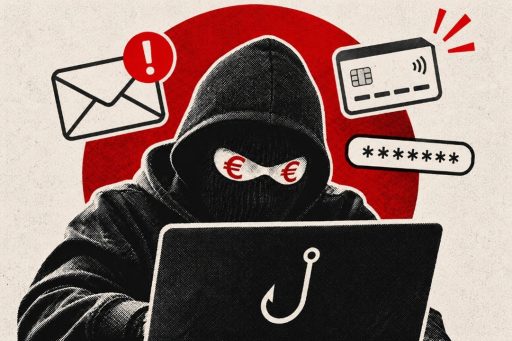
Whilst in our previous post we explained the legal and case-law basis for the offences of fraud and computer fraud, it is now time to get down to the nitty-gritty and see, step by step, how those who target businesses operate.
All it takes is a well-written email, sent at just the right moment, for a business to lose in a single morning what it has taken years to earn: the Spanish courts have heard cases of fraud totalling almost 22 million without anyone having breached a single system[1]. And this is by no means an isolated risk: in 2025, the Cybersecurity Helpline run by the National Cybersecurity Institute (“INCIBE”) handled nearly 143,000 enquiries – that is, almost 400 a day. Therefore, understanding how these cybercriminals operate is the best way to prevent the damaging consequences of their attacks.
1. A scam that isn’t improvised
The first thing to understand is that these scams are not the result of chance, but rather the outcome of a meticulous process.
Criminals begin by selecting their victim. They prefer companies with regular transactions, numerous suppliers, processes of growth or change, or a wealth of public information about their structure. They then study the company in depth: its website, professional networks and press releases enable them to map out the organisational chart, identify who authorises payments and understand how the company communicates. With this information, they prepare the scam: they create email addresses almost identical to the official ones, mimic the style of senior managers, or gain access to genuine accounts belonging to employees or suppliers. Only then do they strike, exploiting moments of vulnerability: the absence of key staff or a period of high pressure. Once the money has been obtained, they make it disappear through channels that are difficult to trace, primarily cash and cryptocurrencies.
None of this requires extensive technical knowledge. What it does require is patience and a great deal of information about the victim, much of which is published by the company itself. That is why the weak link is rarely the IT system and almost always the procedure: the order that nobody checks, the change of account details accepted via email, or the password provided over the phone.
With this pattern in mind, let us now look at the specific behaviours through which the attack usually takes place.
2. Common types of fraud[2]
Economic Criminal Law and Criminal Compliance
Specialists in economic and corporate crimes. Criminal defence in complex cases and plans for the prevention of crimes and money laundering. We act before national and European courts with total rigour. Learn moreA. CEO fraud and its variants
CEO fraud is a form of identity theft in which the criminal poses as a senior executive of the company to persuade an employee to authorise a payment. They do not need to gain access to any system: all it takes is an email, a phone call or a message that is convincing enough. The Madrid Provincial Court describes it as a fraud that “combines social engineering and phishing techniques” (SAP Madrid (Section 11) 74/2022, 28 February).
The script rarely varies: an employee with authorisation to make payments receives a message from their supposed superior asking for help with a transaction that is “urgent and confidential”. The attack plays on a sense of urgency, trust and the fear of disobeying a superior, and almost always occurs when the person in charge is absent or unavailable. The phrases we commonly encounter in practice will sound familiar; for example: “I need you to make this transfer before 2.00 pm; I trust your discretion”; “I’m in a meeting and can’t speak right now, but it’s urgent”; “Hello. Are you free right now? Contact me on WhatsApp – here’s my number”.
The statements confirm that the script is repeated almost word for word:
- The auditor who “endorses” the transaction. In SAP Madrid (Section 18) 28/2022, dated 27 January, the treasury director of an automotive subsidiary received a call from a fake employee of the audit firm regarding a transaction “of an extremely confidential nature” and, subsequently, emails from the alleged managing director concerning the secret purchase of a company in Hong Kong. The loss amounted to 4,782,530.58 euros.
- “Even in my presence”. In Madrid High Court of Justice (Social Chamber, 1st Section) Judgment No. 172/2020, dated 14 February, the fake CEO warned the employee not to say anything “even in my presence”. When the bank rejected a transfer order for 2.5 million “for exceeding all limits”, he asked her to split the payment. The company lost 3.5 million and the criminal case was dismissed “due to the lack of a known perpetrator”.
The most recent – and most disturbing – method involves the use of cloned voices (deepvoice): the employee receives a call in the CEO’s voice, recreated using artificial intelligence, and transfers the money, convinced they are speaking to their boss. Even more alarmingly, the leap to video calls has already taken place: in 2024, an employee at the engineering firm Arup in Hong Kong made 15 transfers totalling some 25.6 million dollars following a video conference in which the finance director and his colleagues were AI-generated recreations[3]. Seeing and hearing the boss is no longer a guarantee that it is actually him.
Criminal classification. Here, it is the employee themselves who orders the payment, having fallen victim to deception. It therefore falls under the classic fraud offence set out in Article 248 of the Criminal Code: deception, error, act of disposal and loss.
B. BEC or the tampered invoice
In a BEC (Business Email Compromise), the criminal does not pretend to be the boss, but rather the supplier or the client. Their aim is to infiltrate a genuine business relationship and, at just the right moment, communicate a change of bank account details: the company pays a genuine invoice, for the correct amount and within the agreed timeframe, but into an account controlled by the criminal.
Two ways of infiltrating the conversation:
- Hacking into the supplier’s or customer’s real account – by infecting their computers with malware or stealing their credentials – and sending emails from that account. This is the most dangerous method, because as it originates from genuine accounts, ‘it dispels the usual suspicions about fake or unknown senders’ (SAP Almería (3rd Section) 132/2025, of 24 March, in a fraud case involving 106,480 euros).
- Impersonating the account using a fake email address that is almost identical to the genuine one. In a company lacking controls, this second method proves just as effective.
Once inside: the ‘man-in-the-middle’ attack. Whichever method is used, the criminal ends up positioned invisibly in the middle of the conversation between the customer and the supplier. They read the emails, learn how invoices are issued and when payments are made, and, when the time comes, replace the genuine invoice with an identical one bearing a different account number. The manipulation is not discovered “until some time later, when the supplier, having failed to see the payment credited to the account specified on their invoice, contacts the customer” (SAP Cantabria (2nd Section) 609/2023, 24 November). By then, the money is usually beyond the company’s reach and, in many cases, beyond the reach of the law.
What the courts say:
- Two companies, two third-party accounts. In Supreme Court Judgment (Chamber 2, Section 1) 815/2024, of 26 September, the perpetrators installed a virus via mass emails sent from an IP address located in Nigeria. They monitored the emails of two companies that were paying each other’s invoices and replaced each company’s account details with those of a ‘cyber mule’.
- The warning signs nobody spotted. In the Supreme Court of Justice of Aragon (Social Chamber, Section 1) Judgment 696/2021, of 8 November, the email arrived from the supplier’s usual account, but without a signature or logo. A sum of 40,683.10 euros was paid.
Criminal liability. Once again, the person ordering the transfer is a deceived employee: fraud under Article 248 of the Criminal Code, usually in conjunction with the forgery of the invoice or bank statement.
C. Phishing, smishing and vishing
In these schemes, the criminal impersonates a trusted organisation: a bank, the Tax Authority, a courier company, etc. The aim is almost always the same: to obtain online banking credentials to access the account and transfer the money. What varies is the channel used: email (phishing), text message (smishing) or a telephone call (vishing).
Phishing is the original form of the scam. The term derives from ‘password harvesting fishing’. The Supreme Court summarises it with this image: the perpetrator ‘fishes for protected data’ that gives them access to accounts (Supreme Court Ruling 834/2012, of 25 October). Smishing and vishing extend the fraud to text messages and telephone calls, respectively.
How it works. The typical scheme combines several channels:
- The preparation. The criminal acquires a ‘toolkit’ containing software, lists of compromised devices from which to send messages or host fake websites, and databases of email addresses or telephone numbers. They then clone the website of a well-known organisation and host it at an address similar to or identical to the genuine one.
- The bait. They send mass emails or text messages that mimic the language, format and branding of the impersonated organisation. The pretext usually creates a sense of urgency or alarm: unauthorised access, a blocked account, an unrecognised charge, a held parcel or a tax refund.
- The trap. The link leads to a page “exactly the same as the legitimate one”, where the victim enters their username, password or card details (SAP Valencia (2nd Section) 456/2013, 5 June). In other cases, the message prompts the victim to call a number or download an infected app.
- Bypassing the second factor. Passwords are not always enough, as the bank requires a verification code to carry out transactions. To obtain this, the criminal calls the victim pretending to be from the bank and asks for the code. This is where vishing comes into play[4].
- Account takeover. Once inside the online banking system, the criminal orders transfers to third-party accounts or links their own device to continue carrying out transactions. The money is transferred in a matter of minutes.
Spoofing: when the sender is genuine, but the person writing the message is not. The classic clue of an unknown sender no longer works, because the criminal can falsify who is sending the message or who is calling: they hire a service that allows them to send text messages with any sender ID they choose, so that the fake message appears in the same thread as the bank’s genuine messages. The same applies to calls: the real customer service number appears on the screen (SAP Asturias (Section 6) 339/2026, of 2 September).
Criminal classification. Here, the money is withdrawn from the account as a result of the criminal’s actions within the system, not due to a deliberate action by the company: this falls squarely within the scope of the computer fraud offence under Article 249(1)(a) of the Criminal Code.
3. Conclusion
An email, a text message or a phone call: the criminal changes their guise, but not their strategy. They choose their victim, study them thoroughly, prepare the deception and strike at the moment of greatest vulnerability. Afterwards, the money vanishes in a matter of minutes. What they are looking for is not a system failure, but an employee who trusts without verifying. And with cloned voices and video calls recreated by artificial intelligence, not even seeing and hearing the boss guarantees that it is actually him.
That is why, at Ayuela Jiménez, we have lawyers specialising in Economic Criminal Law and Criminal Compliance who advise companies on how to deal with this type of fraud. Should any doubts or incidents arise, having an expert team on hand makes all the difference.
