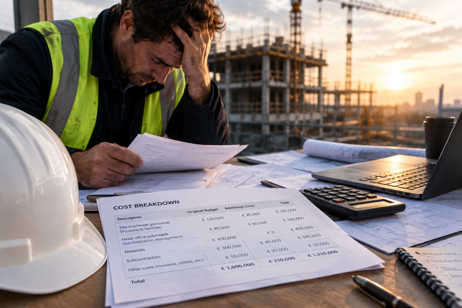
A construction project that runs eight months longer than planned not only delays handover but also forces the contractor to continue paying for work that should have been completed. The site manager and foreman continue to work, the crane remains hired, the site huts are still in place and the insurance policies remain in force. Added to this are the costs of the company’s central organisation, which continues to provide support for the project.
Where the delay is not attributable to the contractor, these costs may give rise to a claim for overheads. However, the mere fact that the works have taken longer than anticipated is not sufficient to justify the amount claimed. How are the costs arising from the extension quantified? What about head office expenses, which cannot always be directly linked to a specific project? And to what extent can calculation formulas be used to demonstrate the loss suffered?
These questions, which are frequently raised in the construction sector, explain why general expenses arising from delay are one of the most contentious items in international construction arbitration. The success of a claim depends not only on there being a delay attributable to another party, but also on correctly identifying the costs claimed, avoiding duplication and proving that financial loss has actually occurred.
1. Not all costs are the same
The first step in making a robust claim is to correctly distinguish between the types of costs that may arise from the delay.
In international construction contracts, it is common to distinguish between ‘site overheads’ – that is, the general costs associated with the operation and organisation of the construction site – and ‘head office overheads’, which correspond to the overheads of the head office. Although the terminology does not exactly match the Spanish classification, distinguishing between these two categories is essential to avoid duplication and ensure that costs which may be recoverable are not omitted from the claim.
|
Concept |
Examples | Does it increase if the works are delayed? |
|
Direct costs |
Materials, labour for construction and machinery specific to a particular construction unit. These are the essential costs for carrying out the works. |
As a general rule, no. They do not increase simply because the timeframe is extended, although additional costs may arise for other reasons. |
|
Indirect project costs (site overheads) |
Site manager, foreman, site huts, crane, fencing, security, water and electricity supplies. In other words, these are costs that support the execution of the works without being allocated to a single activity. |
They may increase if it is necessary to maintain resources and facilities for longer than anticipated. |
| Company overheads (head office overheads) | Head office, management, administration and technical department. That is, costs that are not linked to a particular project, but which enable the general running of the company. |
They may give rise to a claim for additional or unabsorbed overheads, but it is necessary to prove the loss and justify its quantification. |
In Spain, the budget for public works follows, as a regulatory reference, the framework set out in Article 131 of the General Regulations of the Law on Public Administration Contracts (RGLCAP). Structural overheads, amounting to between 13% and 17%, and 6% for the contractor’s profit, are added to the budget for physical execution.
Although these percentages are based on public procurement rules and do not automatically apply to private works, they often serve as a reference when drawing up budgets.
2. What can I claim if the works are delayed?
In a claim for delays in the execution of a project, two types of costs, amongst others, may be raised:
- Extension costs. These are the additional costs incurred by retaining, for a longer period, the personnel, materials and organisational resources necessary for the execution of the works. They may include, for example, site staff, the hire of temporary facilities or certain items of equipment. Evidence of these costs may be provided by payslips, invoices, contracts and cost records, provided they justify the additional expenditure and its link to the delay.
- Unrecovered overheads. These are the costs of the company’s central organisation that have not been recouped to the extent anticipated, as they are costs that the project should have financed through its normal turnover. In certain circumstances, the extension or suspension of a project may prevent the contractor from recouping the contribution they expected to receive to cover these costs. Their claim requires proof of the actual loss suffered and justification for its quantification; it is not sufficient merely to demonstrate that the project was extended.
For these items to be eligible for compensation, there must be a contractual or legal basis for attributing liability for the loss to the other party. In particular, it is necessary to determine whether the delay stems from a breach of contract, a risk assumed by the other party, or some other circumstance which, in accordance with the contract and applicable law, gives rise to a right to compensation. Thus, an extension of the completion deadline does not necessarily imply a right to receive compensation.
To this end, the contract is of crucial importance, and particular attention must be paid to the clauses concerning the allocation of risks, notification of delays, financial claims, limitations of liability and time limits for raising objections.
Some standard contracts set specific time limits for notifying a claim. For example, clause 20.2.1 of the 2017 FIDIC Conditions generally provides for a period of 28 days from the date on which the contractor became aware, or ought to have become aware, of the event or circumstance giving rise to the claim.
Failure to comply with these requirements may affect the right to make a claim, depending on the wording of the contract, the applicable legal regime and the consequences provided for in the event of a failure to give notice.
Commercial and Corporate Conflicts
We advise you on the resolution of commercial conflicts: strategic contracts, shareholder agreements, investment, financing for startups and corporate disputes. We negotiate and find effective solutions for your company. Learn more2.1 The calculation: the formulas and their limitations
Overhead costs present a specific difficulty: it is not always possible to allocate a portion of head office costs directly to a specific project. Consequently, in the international construction sector, various formulas are used to quantify certain losses relating to unabsorbed overheads. Among the best known are:
- Hudson: applies the percentage of overheads and profit set out in the tender, prorated over the period of delay.
- Emden: follows the same logic, but uses the actual percentage derived from the company’s accounts.
- Eichleay: used mainly in claims in the United States, this method allocates the actual head office costs amongst the projects in progress on the basis of their turnover.
However, no formula can replace the burden of proof. It is necessary to demonstrate that the loss actually occurred; for example, that the construction company had to turn down other contracts or that its operations were effectively paralysed.
In Spain, the Supreme Court has ruled that overheads must be substantiated both in terms of their existence and their extent. Only when such evidence is inconclusive may a percentage be applied to the material works budget, adjusted for the duration of the delay and the circumstances of the project.
In the recent Supreme Court Judgment 793/2026 of 24 June, the Supreme Court made it clear that general expenses are not presumed; it is therefore essential to prove the actual existence of the loss. In that case, although the delay was attributable to the public authorities, the construction company’s claim for the initial delay in the works was dismissed, as it had claimed a single, lump-sum figure for all damages without proving which part of its expenses corresponded to that delay.
Although this approach relates to public works, it is the primary reference in Spanish law and is equally relevant in arbitration proceedings governed by our law. A claim based solely on a formula runs the risk of being reduced or dismissed.
3. Evidence as a key element
As we have seen, a claim may be well-founded and yet fail, either wholly or in part, if the delay, its cause and its financial consequences are not properly documented. Among the aspects that should be monitored from the start of the works are:
- Contractual notifications: communicating circumstances that may give rise to a claim in the manner and within the time limits set out in the contract.
- Site records: keep daily logs, minutes of meetings, work orders, photographs and documentation regarding the resources deployed and any incidents that occurred.
- Construction programme: keeping schedules up to date and documenting how incidents affected critical activities and the planned completion date.
- Cost accounting: separating project-specific costs from general overheads and retaining supporting documents that enable the identification of additional expenses.
- Analysis of the causes of the delay: distinguish the periods and causes attributable to each party, as well as any concurrent delays, where these are relevant under the contract and applicable law.
- Quantification of the loss: explain the methodology used, justify the baseline data and avoid duplication between the various items claimed.
Preparing a claim whilst the works are being carried out makes it easier to keep records and identify the causes and consequences of each incident. Reconstructing this information years later can prove considerably more difficult.
4. From claim to dispute: how can I claim for the costs?
Identifying the costs and proving the loss is only part of the process. Next, you must determine how and to whom the claim should be made. To do this, you will need to review the contract: the procedure set out, the notice periods and the mechanisms for resolving disputes regarding the right to claim or the amount due.
Although some claims can be resolved without a formal dispute arising, where it is not possible to reach an agreement, the claim must be channelled through the applicable dispute resolution mechanism, whether through the courts or arbitration.
4.1 Why arbitration?
In construction disputes, where technical, contractual and financial issues are intertwined, arbitration offers clear advantages:
- Specialisation: the parties may select arbitrators with experience in construction, engineering or complex contracts.
- Speed: unless otherwise agreed, the Arbitration Act sets a time limit of six months from the date of the response to issue the award, which may be extended by a further two months. Although this time limit is often extended in complex cases, arbitration avoids the successive stages of a court case.
- Flexibility: the procedure is tailored to the complexity of the case.
- Finality: the award is not subject to appeal on the merits. The only remedy available is an application for annulment on strictly defined grounds.
- Confidentiality: the law requires arbitrators, parties and institutions to maintain confidentiality regarding the proceedings.
- International enforcement: thanks to the New York Convention, the award can be enforced in a wide range of countries.
For these reasons, it is advisable to consider arbitration from the outset of contract negotiations and to incorporate an arbitration clause appropriate to the project, taking into account its costs, the anticipated duration of the proceedings and the applicable law. A well-drafted clause, accompanied by rigorous management of evidence from the start of the works, can make a significant difference when a claim arises.
5. Conclusion
Delays in construction works are common, but the financial consequences do not necessarily always have to be borne by the contractor. Where the delay is not attributable to the contractor and there is a contractual or legal basis for a claim, the contractor may recover both the costs of remaining on site for a longer period and the overheads that the project has continued to generate.
However, recovering these costs requires more than simply being in the right. The contract imposes deadlines and requirements that must be met from day one, and the Supreme Court has emphasised that overheads are not presumed; rather, it must be proven that the loss exists and its extent must be demonstrated. For this reason, the preparation of a claim begins during the construction work itself, whilst it is still possible to document each incident and separate its costs.
If the parties fail to reach an agreement, arbitration is a particularly attractive option for resolving construction disputes, as it allows for the involvement of specialist arbitrators and enables complex contractual, technical and financial issues to be addressed jointly.
