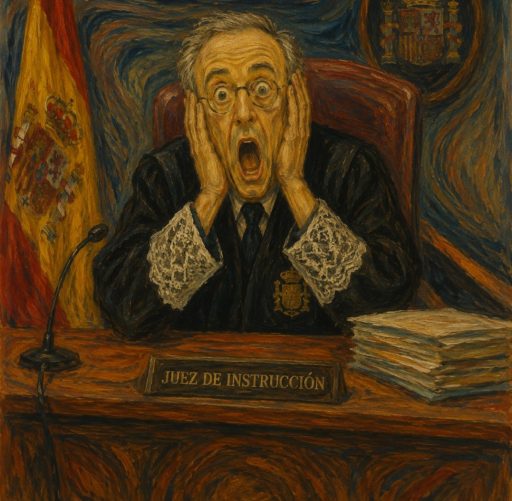
Picture the scene: Madrid, an auction house where a buyer examines a screen print attributed to a great artist, bids on it, wins and takes it home. He hangs the painting. He contemplates it for years, with the satisfaction of owning a work of international significance. Until one day someone tells him the harsh truth: the work is a fake. It is an imitation—well executed, admittedly—produced by someone who copied a style, reproduced its forms and affixed a signature to pass it off as authentic.
The question any person would ask is obvious: is this not an offence against the artist’s intellectual property rights? The answer from the Supreme Court (“Tribunal Supremo”), in its STS 292/2026 of 21 April, is categorical: no.
The facts: 15 forged works, five renowned artists and an auction house in the Salamanca district
The case is straightforward. In January 2018, Norberto signed a mediation contract with the art auction house Setdart, located in the heart of the Salamanca district (Madrid), to sell a total of 16 works of art attributed to various internationally prestigious artists. Of these, 15 turned out to be forgeries, fraudulently produced by him or by a third party.
The catalogue of fraud is striking for the ambition and variety of the artists impersonated: seven screen prints attributed to Eduardo Chillida, one lithograph by Edvard Munch, a diptych and a lithograph by Roy Lichtenstein, one lithograph by Saúl Steinberg, and four lithographs attributed to José Guerrero.
Displayed in the auction house, buyers paid sums ranging from 578 euros for the Steinberg lithograph to over 4,000 euros for each of the Guerrero pieces.
But Norberto was no novice. As early as May 2017, he had sold a forged screen print attributed to Chillida through another art auction house, an operation that was eventually discovered when the buyer ascertained the forgery and reported it. It was that complaint that brought everything crashing down: Group XXVII of the Offences against Intellectual Property unit of the National Police seized the works deposited at Setdart in March 2019.
The question: an offence against intellectual property?
The Provincial Court of Madrid convicted Norberto of two offences: a continuing offence against intellectual property (Art. 270 of the Criminal Code (“Código Penal”) and a continuing offence of fraud (Art. 248 of the Criminal Code), imposing sentences of two years and three months’ imprisonment for the former and one year and nine months for the latter, in addition to compensation orders in favour of the defrauded buyers, the heirs of José Guerrero and Zabalaga Leku S.L., the holder of the intellectual property rights of Chillida.
Up to this point, the story appears to follow its expected course. But the High Court of Justice of Madrid, subsequently upheld by the Supreme Court, introduced a twist that entirely altered the narrative: it acquitted Norberto of the intellectual property offence, upholding only the conviction for fraud.
Herein lies the crux of this judgment. The acquittal does not arise because the court doubted the facts, but for a purely legal reason: what the accused did does not fit the legal definition of plagiarism.
To plagiarise, within the meaning of Article 270 of the Criminal Code, means—according to the definition coined by case law since STS 1276/2006 of 20 September, and reiterated in STS 139/2007 of 23 February—“to copy the works of others in their essential substance”, presenting itself as a “mechanised material activity, largely devoid of intellectual content and still less creative, lacking any originality”, which produces “a state of appropriation and exploitation of the creative labour and intellectual effort of another”. In other words: the plagiarist takes a work that exists and makes it his own. He appropriates the creation of another and presents himself as its author.
What Norberto did is precisely the opposite. He created works—original in the sense that they did not previously exist—and attributed them to celebrated artists who had not produced them. He did not appropriate Chillida’s authorship; he foisted upon Chillida the authorship of something Chillida never made. It is, if you will, the photographic negative of plagiarism: rather than appropriating another’s work, he contaminated another’s name with a work of his own.
The Court formulates this with an expressiveness unusual in judicial prose: “however curious or paradoxical it may seem, attributing to famous or renowned artists that which was not created by them is not, in this case, an offence against intellectual property”.
Thus, the judgment sets out a rigorous technical analysis of the structure of Article 270 of the Criminal Code. The typical conducts described by this provision—reproduction, distribution, communication to the public, plagiarism—protect, respectively, the author’s economic or exploitation rights. The exception is plagiarism, which protects a facet of the author’s moral right: specifically, the right to “demand recognition of one’s status as the author of the work“.
However, all these conducts presuppose something conspicuously absent here: the prior existence of an authentic work upon which the infringement is committed.
The private prosecutors did not accept defeat. Their final argument was the reform of the Criminal Code enacted by Organic Law 1/2015, which had expanded Article 270 with an open clause: “any other form of economic exploitation” of copyright. Under that formula, they contended, it would be possible to encompass the conduct of falsely attributing works to an artist, since whoever signs a painting with Chillida’s name is, in some way, economically exploiting his creative prestige. The Public Prosecutor’s Office supported this thesis.
The Supreme Court rejects this interpretation firmly, describing it as “voluntarist and strained”. The reasoning is systematic and relies on Article 2 of Royal Legislative Decree 1/1996, which defines intellectual property as the set of personal and economic rights that confer upon the author “full disposal of and the exclusive right to exploit the work”. Attributing a work to someone who has not participated in it, the Chamber states, “does not affect intellectual property rights” as thus configured by law: there is no economic exploitation of any component of those rights, because no pre-existing work of the author is being exploited.
Economic Criminal Law and Criminal Compliance
Specialists in economic and corporate crimes. Criminal defence in complex cases and plans for the prevention of crimes and money laundering. We act before national and European courts with total rigour. Learn moreWhat there is: a perfectly constructed fraud
That the conduct does not constitute an offence against intellectual property does not mean it goes unpunished. What Norberto did has a name in Criminal Law: fraud (Art. 248 of the Criminal Code).
The Supreme Court confirms the conviction for a continuing offence of fraud: there was deception and it was sufficient to induce error in the buyers, who acquired the fraudulent works through an auction house—a channel that projects an appearance of authenticity and professionalism—in a context of apparent commercial normality, at prices that were not suspiciously low. Nothing invited the buyers to doubt the authenticity of what they were acquiring.
Norberto attempted to rely on the principle of victim self-protection, arguing that the buyers could have verified the authenticity by consulting the artists themselves, experts or official institutions. The Court is emphatic: requiring such precautions “is excessive for those who in good faith acquire paintings at an auction house”, concluding that one cannot demand of a person who “contracts in good faith under normal circumstances, with the proprietor of a premises open to the public” a level of distrust that the market system itself does not require.
What this judgment means for the art world
STS 292/2026 delivers a clear message: Criminal Law does not punish as an offence against intellectual property the imitation of an artistic style signed in the name of a recognised artist. It can punish it, and does, as fraud, but the specific protection of intellectual property does not extend to this conduct.
On a conceptual level, the judgment highlights a reflection: in the art market, where the signature is the factor that multiplies the economic value of a piece, the conduct of producing forged works and foisting them upon great names falls outside the perimeter of the intellectual property offence. As the High Court of Justice itself acknowledges in its appellate judgment, the facts are “readily conceivable as prejudicial, at least morally, to the artists to whom screen prints that were not theirs are falsely attributed, and reprehensible”, but that is not sufficient to constitute the offence, this circumstance being protected through civil proceedings.
The paradox is plain: whoever copies a work by Chillida and signs it with his own name commits an offence against intellectual property; whoever creates a work from scratch and signs it as Chillida does not. Criminal Law draws the line precisely there. What lies on the other side—the reputational damage, the artistic discredit, the contamination of a creator’s legacy—must be pursued through other channels. And that is, perhaps, the true conversation that this judgment opens.
